
The Strategic Role of Intent-Based Networking in Modern Enterprise Architecture
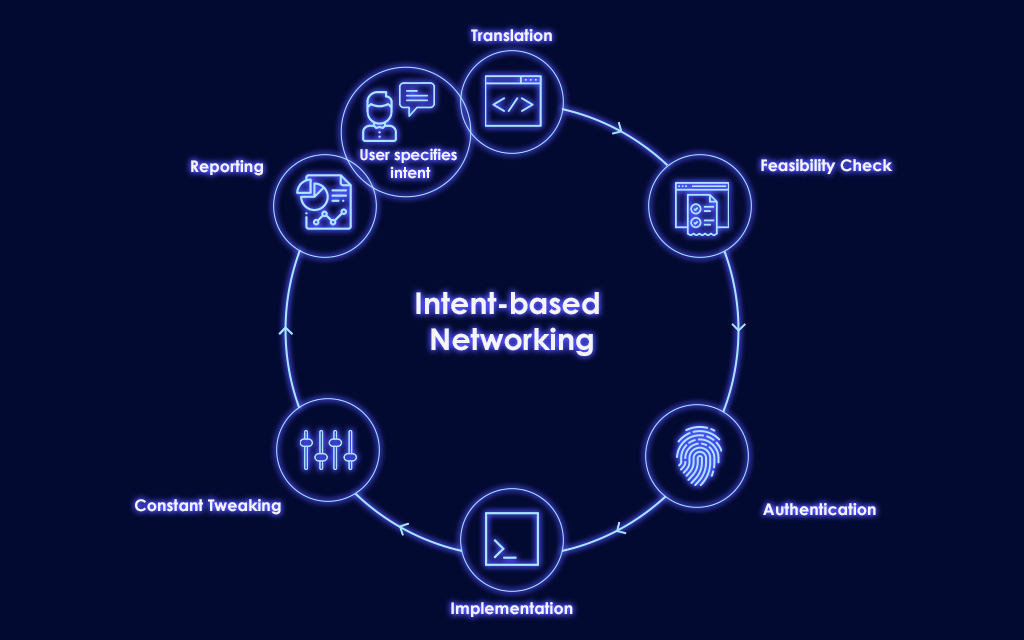
As digital transformation accelerates across industries, networking has evolved from a background enabler to a core strategic component of enterprise architecture. Traditional manual network management cannot keep pace with the dynamic needs of hybrid cloud environments, edge computing, and security-first infrastructures. The solution lies in Intent-Based Networking (IBN) — an advanced paradigm that bridges business intent with automated, intelligent network control.
This article explores the strategic importance, architectural depth, and operational advantages of intent-based networking in complex enterprise ecosystems, emphasizing its transformative potential beyond simple automation.
Understanding Intent-Based Networking Beyond Automation
Intent-Based Networking goes far beyond automating configurations or provisioning devices. It fundamentally redefines how networks are designed, deployed, and managed by aligning them directly with business goals and application needs.
In essence, IBN allows administrators to express what they want the network to achieve — the intent — while the system determines how to make it happen through automated enforcement, verification, and optimization.
The IBN system performs four core functions:
-
Translation and Validation: Converts business intent into specific network policies.
-
Automated Implementation: Deploys these policies across physical and virtual infrastructure.
-
Continuous Assurance: Monitors the network to ensure intent compliance in real-time.
-
Learning and Optimization: Uses AI and machine learning to adapt to performance and security changes dynamically.
Unlike traditional SDN or programmable networking, IBN introduces a closed-loop system — ensuring that network behavior always aligns with the declared business outcomes.
The Shift from Reactive to Predictive Networking
Enterprises are no longer satisfied with reactive management. As data volumes surge and applications become distributed across multi-cloud architectures, predictive networking becomes crucial.
IBN leverages AI-driven analytics and telemetry data to anticipate anomalies before they occur. Instead of merely reacting to outages or latency issues, the network can predict congestion points, reroute traffic dynamically, and even suggest optimal policy adjustments.
This predictive capability minimizes downtime and enhances network resilience, especially in industries like finance, healthcare, and manufacturing, where milliseconds matter.
Architecture of Intent-Based Networking Systems
An effective IBN architecture combines three foundational layers:
1. Intent Layer
This top layer captures business intent in a declarative manner. For example, an enterprise may define policies like “prioritize video conferencing traffic” or “restrict sensitive data transfer outside the private cloud.” The system translates these directives into actionable configurations.
2. Policy and Analytics Layer
This layer functions as the cognitive core of IBN. It uses AI, ML, and analytics to assess the feasibility of intent, predict outcomes, and ensure alignment with existing network states. It continually refines intent implementation using real-time data.
3. Execution Layer
This layer handles automated enforcement, deploying policies across routers, switches, firewalls, and virtual appliances. It also provides continuous monitoring and self-healing capabilities to maintain intent integrity.
Together, these layers establish a self-operating network that dynamically adapts to business and environmental changes.
Integration of IBN with Cloud and Edge Environments
As enterprises migrate workloads to multi-cloud and edge ecosystems, ensuring policy consistency and performance optimization becomes complex. Intent-Based Networking offers a unified control fabric that spans across on-premises, cloud, and edge nodes.
-
Multi-cloud Management: IBN ensures consistent policy application across AWS, Azure, and Google Cloud environments without manual intervention.
-
Edge Optimization: It prioritizes latency-sensitive workloads like IoT analytics or real-time video processing.
-
Security Consistency: Centralized intent policies ensure that compliance and access rules remain identical across distributed environments.
This integration enables end-to-end visibility and automation, crucial for organizations with geographically distributed assets and workloads.
Intent-Based Security: The Evolution of Zero Trust
Modern security demands are far beyond static firewall rules or perimeter defenses. IBN naturally aligns with Zero Trust Network Architecture (ZTNA) by continuously validating access and enforcing least-privilege principles.
In IBN, security intent could be expressed as “only allow encrypted traffic between finance servers and databases.” The system translates this into network policies, monitors traffic for deviations, and automatically isolates anomalies.
By integrating security intent directly into the network fabric, enterprises can eliminate human error, enforce compliance dynamically, and minimize attack surfaces.
Operational Benefits and Business Impact
Implementing IBN delivers both technical and strategic business benefits:
-
Reduced Operational Complexity: Automation eliminates the need for manual configuration, lowering administrative overhead.
-
Faster Deployment Cycles: Policies can be applied network-wide in seconds, supporting agile DevOps environments.
-
Continuous Compliance: Built-in verification ensures adherence to regulatory standards like GDPR or HIPAA.
-
Improved Resource Utilization: AI-driven analytics optimize bandwidth and routing based on real-time demand.
-
Enhanced Service Reliability: The predictive nature of IBN minimizes outages and service degradation.
Ultimately, IBN allows organizations to transform their networks from cost centers into strategic enablers of innovation.
Challenges and Implementation Considerations
While IBN offers immense potential, successful implementation requires addressing several challenges:
-
Data Accuracy: IBN depends heavily on telemetry and analytics data. Incomplete or inaccurate data can lead to incorrect decisions.
-
Integration Complexity: Legacy systems may lack APIs or compatibility for seamless integration.
-
Change Management: IT teams must transition from device-level control to intent-based workflows, demanding cultural adaptation.
-
Vendor Lock-In Risks: Some IBN solutions are proprietary, potentially limiting interoperability.
-
Security Governance: As automation increases, ensuring secure access to automation interfaces is critical.
To overcome these challenges, enterprises must invest in network observability tools, standardized APIs, and continuous team training.
Future Outlook: Autonomous Networking and Beyond
The evolution of IBN is steering networks toward full autonomous operation — where the network not only enforces intent but also formulates new intents based on context.
For instance, an AI-driven IBN system could detect an application performance drop and automatically generate a new policy to optimize routing or bandwidth allocation. As AI models mature, networks will become self-optimizing ecosystems, capable of learning, adapting, and securing themselves with minimal human oversight.
The convergence of IBN with quantum networking, edge AI, and 6G technologies will further enhance its predictive capabilities, making networks truly cognitive and context-aware.
Conclusion
Intent-Based Networking marks a paradigm shift in how enterprises manage connectivity, security, and performance. By uniting AI, automation, and business logic, IBN transforms networks into intelligent platforms that understand and execute intent with precision.
For enterprises navigating multi-cloud environments, security challenges, and data-driven operations, IBN represents more than an upgrade — it’s a strategic imperative for achieving agility, resilience, and long-term competitiveness.
Frequently Asked Questions (FAQs)
1. How does Intent-Based Networking differ from Software-Defined Networking (SDN)?
While SDN provides programmable control, IBN adds an intelligence layer that understands business intent, validates outcomes, and ensures continuous compliance automatically.
2. Can IBN integrate with legacy infrastructure?
Yes, most modern IBN platforms support hybrid environments through APIs, adapters, and abstraction layers that connect with legacy devices.
3. What role does AI play in IBN?
AI enables predictive analytics, anomaly detection, and continuous assurance by learning from network data to improve decision-making.
4. How does IBN enhance network security?
IBN integrates security intent directly into network policies, continuously monitoring traffic and automatically enforcing Zero Trust principles.
5. Is IBN suitable for small and mid-sized enterprises?
Yes, cloud-based IBN solutions provide scalable models that fit both SMEs and large enterprises, offering automation without heavy infrastructure investments.
6. What metrics are crucial for measuring IBN success?
Key metrics include policy compliance rate, mean time to repair (MTTR), automation efficiency, and overall network uptime.
7. What are the prerequisites for adopting IBN?
A strong foundation in SDN, network automation, and data analytics is essential before transitioning to a fully intent-based environment.